UpTrajectory Review
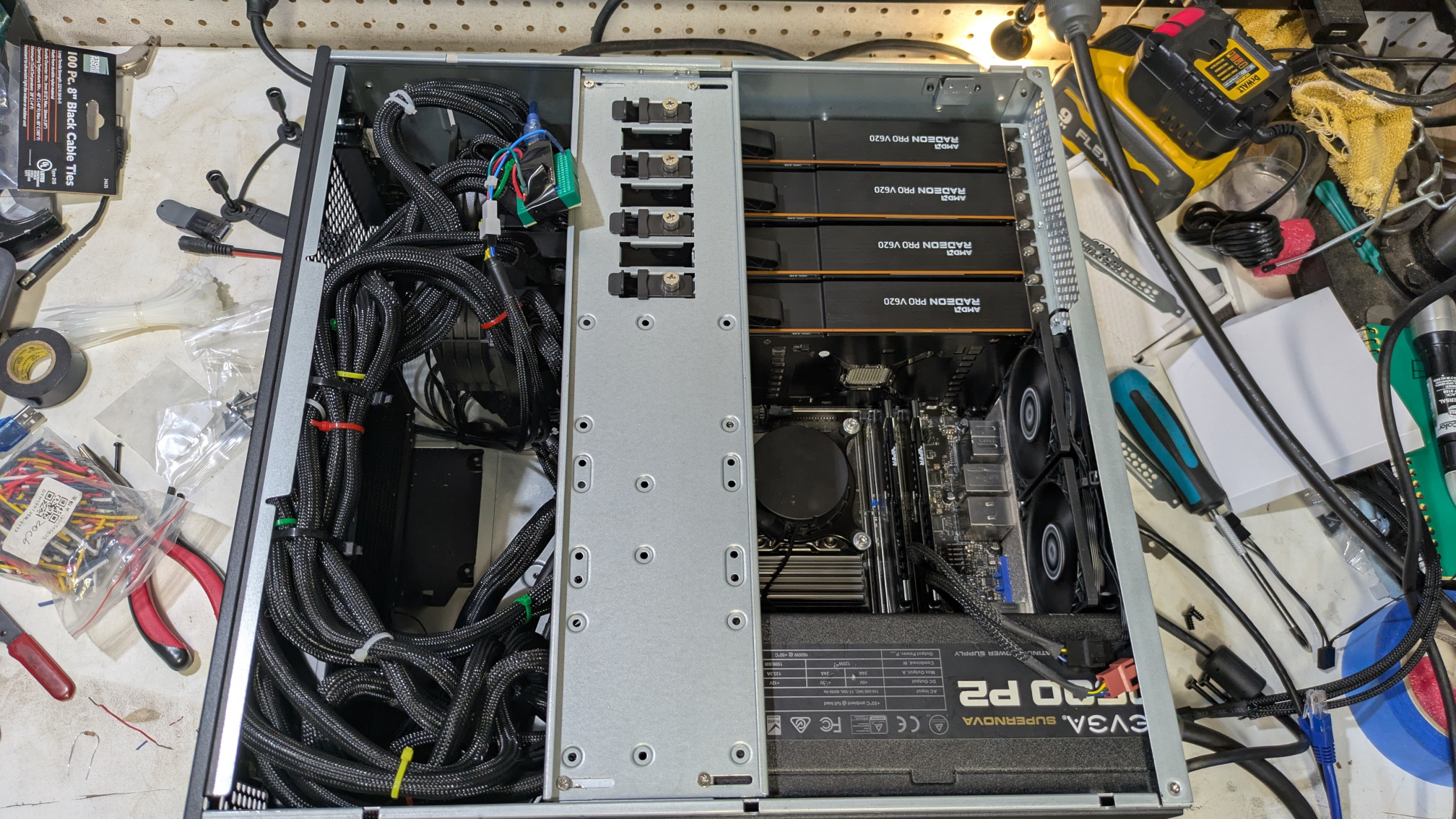
An engineer named J. D'Agostino has documented building a functional AI training rig from literal scrap metal and second-hand server parts, spending roughly $2,000 to replicate hardware that would cost tens of thousands new. The project, chronicled in a detailed technical blog post, centers on a decommissioned 4U server chassis, used Tesla V100 GPUs pulled from retired data-center equipment, and considerable improvisation around power delivery, cooling, and physical mounting. What reads as a hobbyist build diary carries weight because it arrives at a moment when AI infrastructure costs are becoming a genuine barrier to entry for small operators who want to train or fine-tune models rather than merely rent API access to someone else's.
For small-business operators, the significance is not that everyone should start dumpster-diving for GPUs. It is that the economics of AI ownership are becoming negotiable in ways the major cloud providers and hardware vendors do not emphasize. D'Agostino's build demonstrates that the depreciation curve for enterprise AI hardware is steep and largely invisible to buyers who purchase through normal channels. A Tesla V100 that cost $10,000 new four years ago now trades for hundreds of dollars in secondary markets, yet retains substantial capability for training smaller models or running inference at scale. The scrap-metal approach is not elegant, but it exposes how much margin sits between actual hardware cost and the price of convenience.
What is genuinely new here is the documentation quality and the implicit argument structure. D'Agostino is not merely showing off a contrarian build; he is making a case that the dominant narrative of AI as a cloud-only, capex-heavy capability is partially a sales construct. We are somewhat skeptical of the universal applicability. The project demands significant electrical infrastructure, tolerance for noise and heat, and technical skills that most small businesses do not have in-house. The 51-comment Hacker News thread suggests the community is split between admiration and warnings about fire hazards, reliability, and the hidden costs of maintenance. The post does not fully address these tradeoffs, which limits its value as a blueprint even as it succeeds as provocation.
The downstream effects matter more than the build itself. If secondary-market GPU availability grows as data centers refresh to newer accelerators, a cottage industry of refurbishers and integrators serving small businesses could emerge, analogous to the used Cisco router market of two decades ago. Conversely, if Nvidia and cloud providers successfully restrict driver support, firmware access, or software compatibility for older hardware, they could close this arbitrage window. For small businesses currently paying OpenAI or Anthropic monthly fees that scale with usage, the scrap-metal route offers a fixed-cost alternative that becomes economical at moderate scale, but only if the organization can absorb operational complexity that SaaS pricing is explicitly designed to eliminate.
Watch whether major cloud providers respond to this kind of visibility by introducing lower-commitment bare-metal offerings or by more aggressively obsoleting older hardware through software. For operators considering action now, the practical path is not replication but education: understanding what your actual inference or training load requires, testing whether smaller open models suffice, and calculating the crossover point where ownership beats rental. D'Agostino's post is worth reading not as a manual but as a proof that the AI infrastructure market has more price elasticity than advertised, and that patient capital can exploit gaps between enterprise depreciation cycles and small-business need.
The broader point is strategic patience. Small businesses are repeatedly told that AI adoption requires immediate subscription to expensive services or surrender of data to platforms. The scrap-metal build, however impractical for most, cracks open the possibility that ownership models may return for operators willing to tolerate friction. The question is not whether to build a box of scraps, but whether your technology strategy assumes vendor pricing is fixed and inevitable. D'Agostino suggests it is not, and that alone justifies the attention this project has received.
Takeaway: Calculate your AI workload's crossover point where used hardware ownership beats cloud API fees before assuming SaaS is your only option.
Excerpt from the original — Hacker News (front page)
Article URL: https://jdagostino.github.io/ai-pt1-box-o-scraps/index.html
Comments URL: https://news.ycombinator.com/item?id=49288293
Points: 111
# Comments: 51