UpTrajectory Review
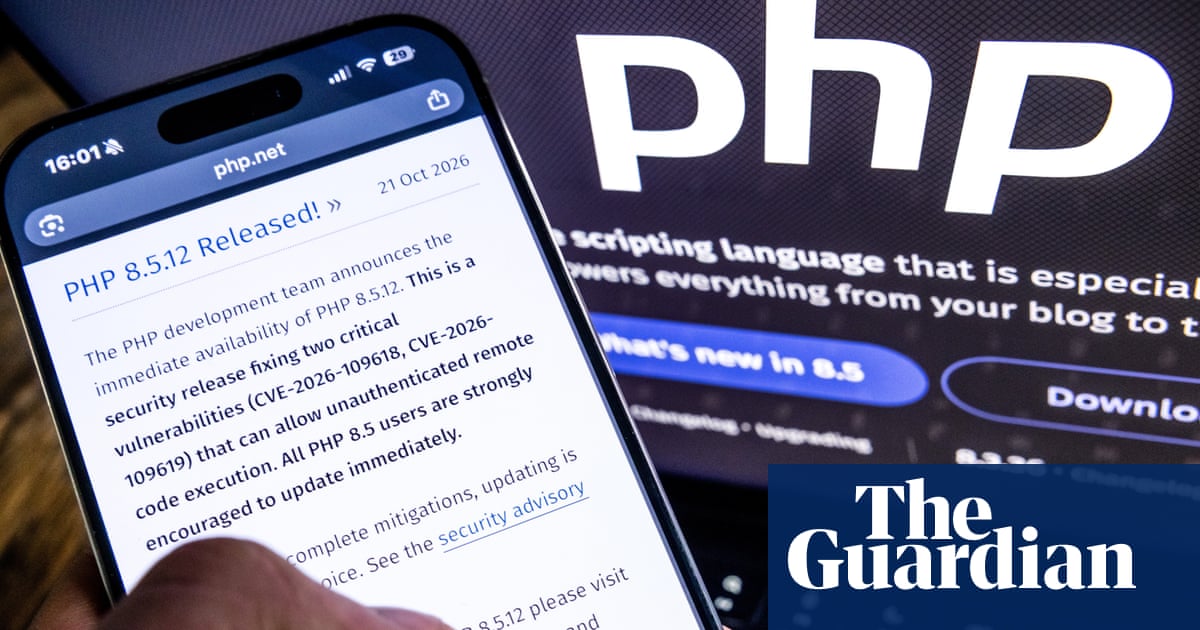
A serious vulnerability in PHP, the scripting language that underpins roughly 70% of all websites, has triggered precautionary shutdowns of government and public-facing sites across Belgium, the Netherlands, Finland, France, and Germany. Rather than risk exploitation while patches are deployed, administrators took the unusual step of pulling entire properties offline — a defensive move that signals just how severe the flaw is believed to be. The Guardian's report, co-authored by Robert Booth and Aisha Down, frames this as a global incident with active exploitation risk, not a theoretical advisory.
For small-business operators, this is not a distant government IT story. If your website runs on WordPress, Drupal, Joomla, Magento, or virtually any custom-built CMS from the last two decades, PHP is almost certainly the engine underneath it. The mass takedowns by national governments should be read as a loud alarm: if entire countries are willing to eat the cost and visibility loss of going dark, the threat model is serious enough that you should assume your own stack is exposed until proven otherwise.
What stands out here is the scale of the preemptive response. Governments do not voluntarily shutter public services over routine vulnerabilities; the calculus only makes sense when the alternative — a silent breach of citizen data or infrastructure — is worse. That several European nations moved in near-unison suggests coordinated disclosure and a shared assessment of imminent danger. We agree with that posture. What the excerpt does not yet reveal is the vulnerability's specifics — whether it permits remote code execution, data exfiltration, or something else — and that gap matters for prioritizing your own response.
The second-order effects are already visible. Every hour a government site stays dark, citizens lose access to services and businesses lose a trusted reference point. For smaller operators without dedicated security teams, the patch cycle will be slower and messier: shared hosting providers must update PHP across thousands of tenants, plugin compatibility must be verified, and custom code may need manual review. There will also be a wave of opportunistic scams — fake 'PHP security update' emails and malicious patches — aimed at businesses that know just enough to be anxious but not enough to verify sources.
Watch for the CVE disclosure, a PHP project security advisory, and guidance from your hosting provider or CMS vendor in the coming hours. If you manage your own server, update PHP to the patched release immediately and audit access logs for anomalies. If you are on managed hosting, open a ticket and demand a timeline. Do not wait for a breach notification to act — by then, the window has closed.
The broader lesson is structural: PHP's ubiquity is a single point of failure for the entire web economy. Incidents like this will recur. Treat language-level vulnerabilities with the same urgency you would a physical break-in at your storefront — because functionally, that is exactly what they are.
“Websites around the globe have gone dark after a serious vulnerability was found in a computer language used to build much of the world wide web.” — The Guardian US
Takeaway: If your site runs on WordPress, Drupal, or any PHP-based stack, contact your host or patch immediately — governments are going offline rather than risk this vulnerability.
Excerpt from the original — The Guardian US
Precautionary takedowns come as experts say bad actors could exploit vulnerability in language used by 70% of sitesWebsites around the globe have gone dark after a serious vulnerability was found in a computer language used to build much of the world wide web.Belgian, Dutch, Finnish, French and German sites were among those that governments took down temporarily as they scrambled to patch the critical weakness in PHP, a language used by almost 70% of websites. Continue reading…