UpTrajectory Review
Disney is harnessing a custom AI model from Adobe to revolutionize its park design process. This technology aims to streamline the creation of attractions and environmental designs, allowing Disney to produce high-quality assets at an unprecedented speed. By integrating decades of artistic and architectural data, the AI can generate on-brand content efficiently, transforming hand-drawn sketches into 3D models in record time.
For small business owners, this development highlights the potential of AI to enhance creativity and productivity. While Disney's scale is unique, the principles of leveraging technology to improve operational efficiency can be applied across various industries. Operators should consider how AI tools could help them innovate faster and reduce time spent on repetitive tasks. However, it's crucial to remain cautious about over-reliance on technology, ensuring that the human touch in creativity is not lost.
“Our project timelines last five, six, seven years, and our ability to compress that time frame is incredibly important.” — Fast Company
Takeaway: Explore AI tools to streamline your design processes and enhance productivity.
From the original item — Fast Company:
Walt Disney Imagineering, the media and entertainment company’s design and engineering firm behind its parks and cruises, has its own new bespoke AI model from Adobe. The goal is to use the technology to help create attractions and environmental design, like storefronts and architecture, at a pace that wouldn’t otherwise be possible.
The custom AI is build on Firefly Foundry, Adobe’s boutique AI service that trains on a brand’s IP and catalog. For Imagineering, that meant ingesting decades of data, including artist drawings and every architectural diagram and piece of concept art they’ve ever created.
“It’s on people’s laptops, it’s underneath people’s desks, it is in people’s brains,” Walt Disney Imagineering senior vice president of R&D technology and engineering Kyle Laughlin tells Fast Company. “It literally is in dozens of disparate systems that using artificial intelligence now we’re able to unify for the very first time.”
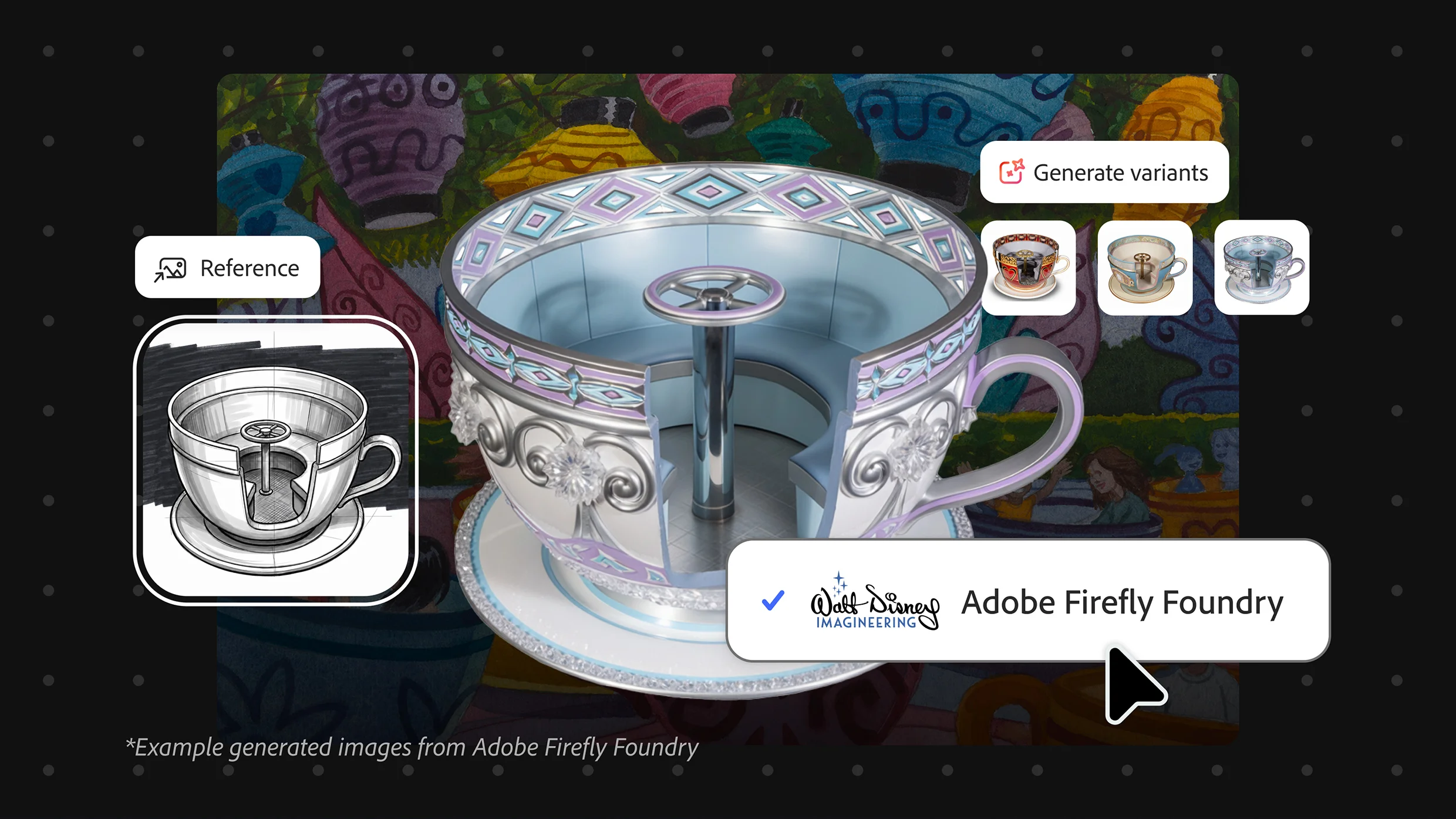
Imagineering’s bespoke AI model is based on billions of parameters capable of generating on-brand Disney assets. A sketch-to-image model turns hand-drawn concepts into 2D concept art, a custom image model generates franchise-accurate creative assets for characters like Mickey Mouse and Lilo and Stitch, and the 3D-modeling tool can turn 2D renderings into prototypes.
What that means is quicker output that all fits the broader Disney brand guide.
“Our project timelines last five, six, seven years, and our ability to compress that time frame is incredibly important as we think about creating high-quality experiences that we can get in front of guests faster,” Laughlin says. Much of the work they do in the early phases is around concepts, and AI will enable them to go from a 2D sketch to 3D view of park assets in a short timespan.
Iteration processes that once took months will now take days, he says. And Imagineers will be able to pre-visualize assets of, say, a building or restaurant facade in a reality headset to make changes early before anything is built in the field when it’s more expensive to make tweaks. That could mean all the difference at a time when Imagineering is under pressure to produce after the Walt Disney Company in 2023 committed $60 billion in investments over next decade in its experiences business.
“This is an unprecedented amount of capital going into everything from theme parks, cruise ships, hotels, food and beverage experiences around the world, and the ability to deliver against that ambition is unlike anything we’ve seen in the history of Imagineering,” he says.
The firm, which traces its founding back to 1952, is responsible turning a universe of IP into a physical, tangible world, bringing Disney magic to life. Keeping everything on brand is no small task.
“Something as iconic as a Disney brand is not one-dimensional,” says Hannah Elsakr, Adobe’s head of new GenAI business ventures. “It’s not a flat file sitting in an asset library, it’s not just a font that we recognize. It’s really how the thousands of small decisions that the creative leaders make each day around creative intent.”
Disney announced an agreement late last year with OpenAI to license its characters to Sora, the company’s short-lived AI short-form video app that shut down in April, and after Disney laid of about 1,000 employees earlier this year, some Marvel fans blamed AI.
Laughlin, the Imagineering executive, says “the most important thing about our workflows is that there are human in the loop,” and says Imagineering “simply can’t find enough resources to do all of the work we have in front of us.
“Our ability to use tools and workflows like the that help us compress that time was incredibly important given the ambition that Imagineering has to deliver the $60 billion worth of investment across our experiences,” he says.
Disney’s parks business along with streaming has helped the company grow to about $9.5 billion in revenue, up 7% year-over-year.