UpTrajectory Review
The article discusses how major homebuilders, particularly Lennar, are adjusting their strategies in response to a cooling housing market. After experiencing record profits during the pandemic, these companies are now offering significant sales incentives to maintain buyer interest and sales volume. The piece highlights the shift in average sales prices and the types of incentives being used, such as mortgage rate buydowns, to attract buyers in a challenging economic environment.
For small business owners in the real estate sector, this trend signals a critical need to adapt to changing market conditions. The aggressive use of incentives by large builders could pressure smaller operators to follow suit or risk losing market share. It's essential to monitor how these adjustments impact overall pricing strategies and buyer behavior, especially in regions experiencing significant market shifts. While the decline in incentive spending may suggest a potential recovery, the ongoing volatility means that operators must remain agile and responsive.
Takeaway: Stay agile in your pricing and incentive strategies to remain competitive in a shifting housing market.
From the original item — Fast Company:
Want more housing market stories from Lance Lambert’s ResiClub in your inbox? Subscribe to the ResiClub newsletter.
During the pandemic housing boom, many publicly traded homebuilders achieved record profit margins as home prices soared and buyer demand ran red hot. Once the national housing demand boom fizzled out in the summer of 2022, many large homebuilders, including Lennar, a giant homebuilder with a $23 billion market capitalization, made affordability adjustments where and when needed to maintain their sales pace or prevent a bigger sales volume pullback.
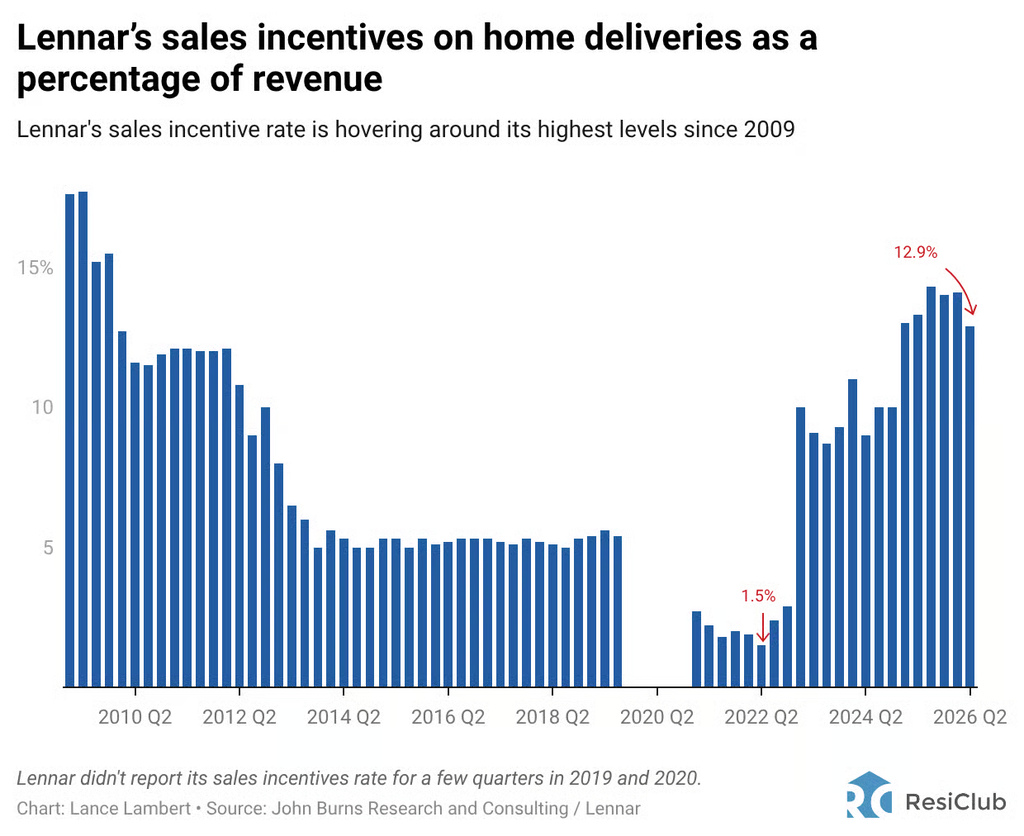
In order to maintain sales in this softer housing market environment, Lennar spent an average of 12.9% of the final sales price on sales incentives, such as mortgage rate buydowns, in Q2 2026. While that’s down from an incentives rate of 14.1% in Q1 2026, it’s still an aggressive incentives rate.
“While this decline may be a leading indicator of margin recovery, the overall market remains choppy as economic and geopolitical crosscurrents mark the way forward,” Stuart Miller, CEO of Lennar, said on the company’s June 12 earnings call.
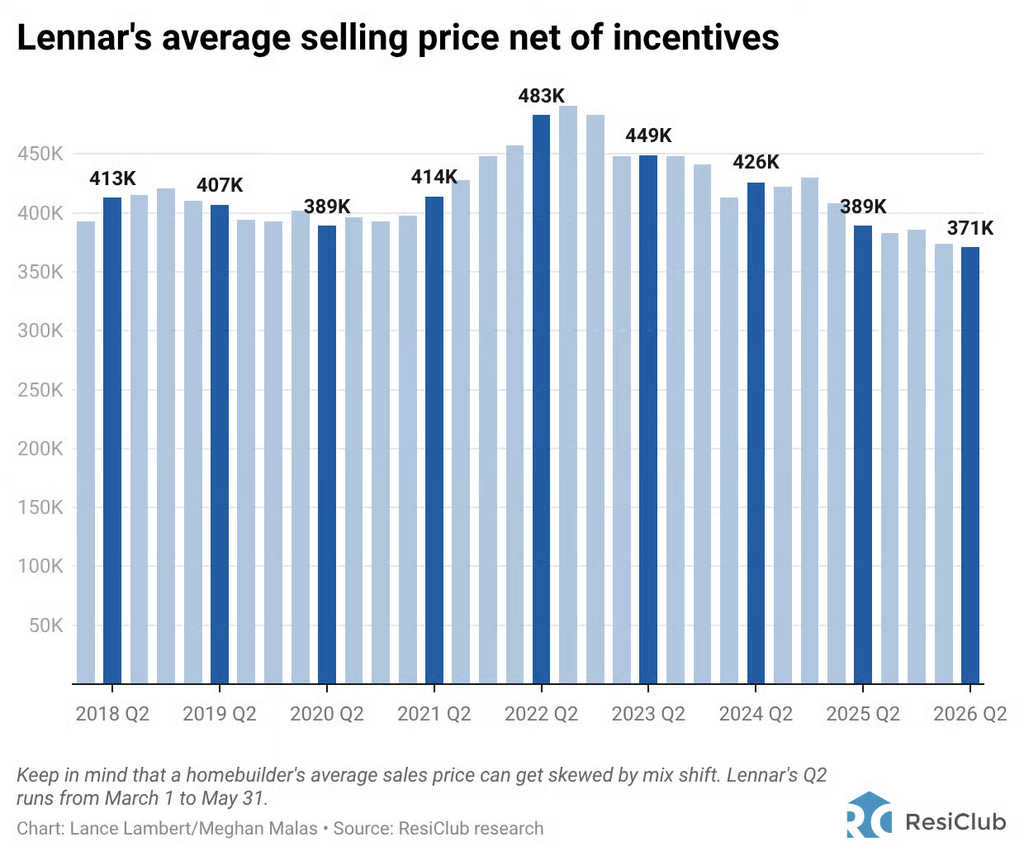
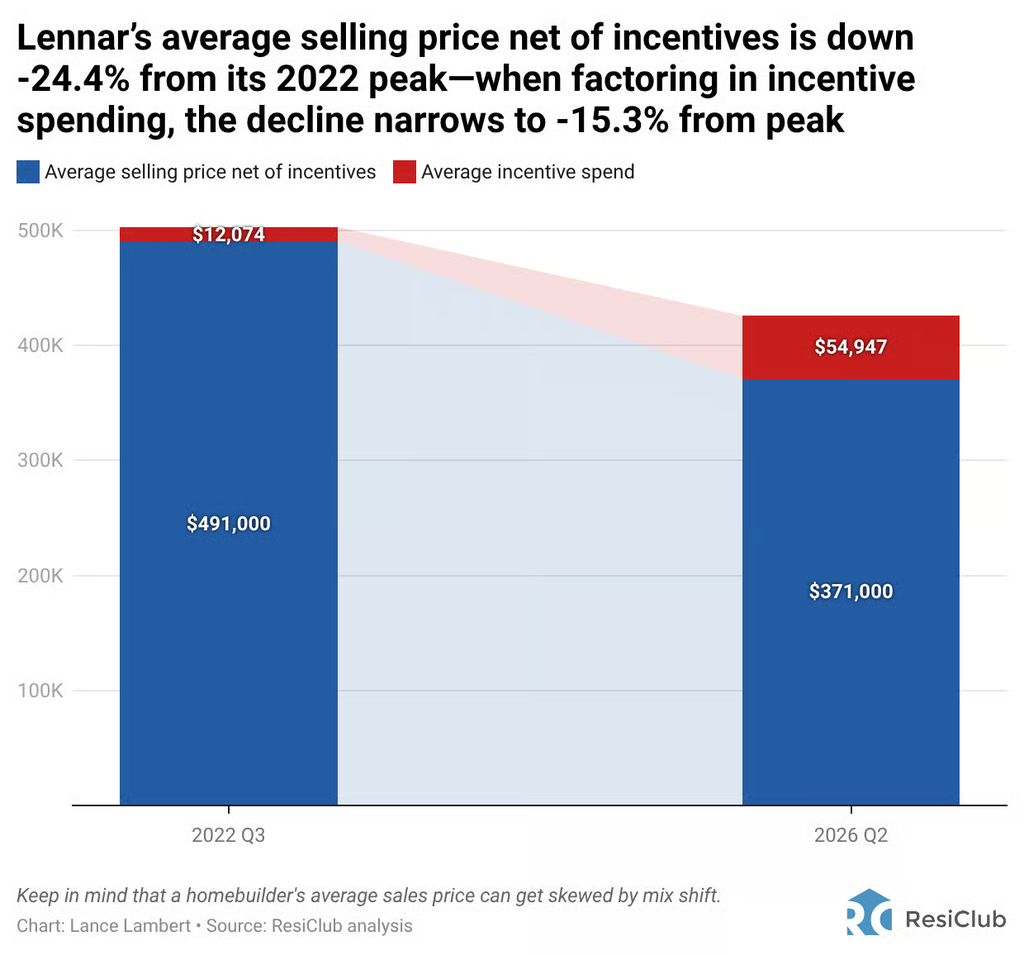
Lennar’s average sales price, minus incentives, came in at $371,000 in Q2 2026—that’s down 4.6% from $389,000 in Q2 2025 and down 24.4% from its cycle high of $491,000 in Q3 2022.
A chunk of that decline is due to mix shift (i.e., pivoting to smaller builds in order to reduce buyers’ monthly payments and help with affordability), and a chunk is driven by outright price cuts and larger incentives/adjustments used to prevent a bigger sales pullback. These adjustments are heavily concentrated in soft Sunbelt pandemic boomtowns like Austin and Tampa, Florida, which have seen greater softening and weakening over the past four years than many markets in the Midwest and Northeast.
In Q3 2022, Lennar spent roughly $12,074 in incentives on a typical home sale, ResiClub estimates. By comparison, in Q2 2026, typical incentive spending by Lennar was $54,947 per home, according to ResiClub estimates.
While many local housing markets in mid-2026 remain choppy, Lennar CEO Stuart Miller on Friday described buyer traffic as “inconsistent” with low urgency, but added that the worst of the margin pressure may be behind them this cycle.
Lennar reported a gross margin of 15.6% for Q2 2026—down from the prior year but up from 15.2% in Q1 2026, reflecting the homebuilder’s elevated incentives and affordability-driven pricing adjustments.
Lennar’s sales incentive rate—an important metric for understanding where homebuilder margins are headed—declined from 14.1% in Q1 2026 to 12.9% in Q2 2026. It’s hardly a dramatic drop, and the rate still remains aggressive.
Miller said “slowly” twice, almost as a warning not to get ahead of it. But he noted the upward incentives trend has let up for Lennar in recent months.
Miller was clear that sequential gross margin improvement is expected to continue through the rest of the year, driven primarily by a shift toward more standardized “core product” and ongoing construction cost efficiencies—not by any assumed acceleration in incentive declines. He explicitly said that they’re not 100% sure where incentives will go, calling any further reduction “potential additional upside.”
And while incentives did ease this quarter, Lennar also trimmed its annual delivery guidance from approximately 85,000 to 82,000 to 83,000 homes—a sign it’s grown a bit more conservative heading into the second half.