UpTrajectory Review
The latest report highlights a paradox in the job market: while overall job growth is strong, many job seekers still face significant challenges. Despite a surge in hiring across various sectors, inflation is outpacing wage growth, complicating the landscape for those looking for work. High-profile layoffs at major companies like Meta and Amazon have garnered attention, but they represent only a small fraction of the broader employment situation.
For small business owners, this report underscores the importance of understanding the dual nature of the current job market. While there may be more candidates available due to layoffs, the persistent inflation means that attracting talent could require competitive compensation packages. Additionally, the renewed hiring momentum could lead to a tighter labor market in the near future, making it crucial for small businesses to act quickly and strategically in their hiring processes.
“This spring really is solidifying that the labor market is returning to a growth pattern.” — Business Insider
Takeaway: Small businesses should prepare for increased competition in hiring as the job market strengthens.
From the original item — Business Insider:
Scott Olson/Getty Images
- The job market is showing revived strength, despite big-name companies announcing layoffs.
- The economy had its best three-month average job growth since early 2024.
- But it’s still hard for some to find a job, and inflation outpacing wage growth is a new issue.
From about 8,000 layoffs at Meta to thousands of cuts at Amazon, media outlets have been following high-profile employment changes.
However, cuts at major tech companies this year represent only a sliver of what’s happening in the massive job market, filled with millions of workers and unemployed Americans across different industries and business sizes.
That larger job market is showing renewed strength, although there are still some bumps in the road. Overall job growth is more robust, layoffs remain pretty low, and it’s not just the healthcare sector keeping it alive. On the downside, wage growth isn’t keeping up with inflation anymore, while rising long-term unemployment and low hiring rates suggest it’s still hard to find a new job if you’re out of work.
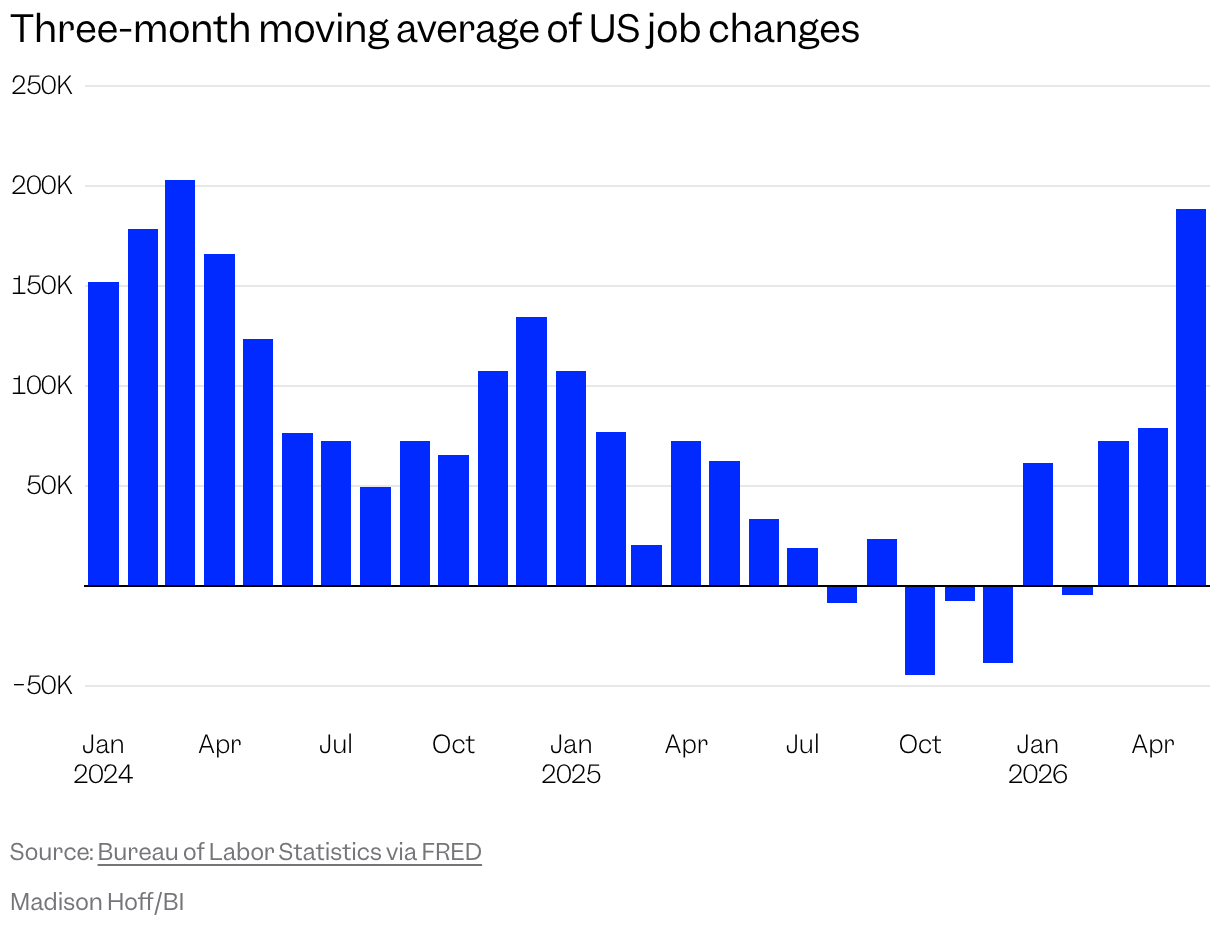
The monthly jobs report out on June 5 showed the economy had three straight months of robust gains through May, well above what’s needed to keep unemployment steady and the highest three-month average since early 2024.
“This spring really is solidifying that the labor market is returning to a growth pattern,” said ZipRecruiter economist Nicole Bachaud. “Businesses are reaccelerating hiring, jobs are growing across different industries, and there’s just a general sense of renewed energy in the market that was largely stagnant for most of the last year.”
With now five months of data in 2026 from the Bureau of Labor Statistics, we break down how the job market is looking.
Overall job growth is at its strongest level in over two years
Let’s first look at the good news.
The US added 172,000 jobs in May, about double the expected gain. The same jobs report showed upward revisions to the previous two months: from a job gain of 185,000 to 214,000 in March and from a gain of 115,000 to 179,000 in April. Together, that makes the highest three-month average since March 2024.
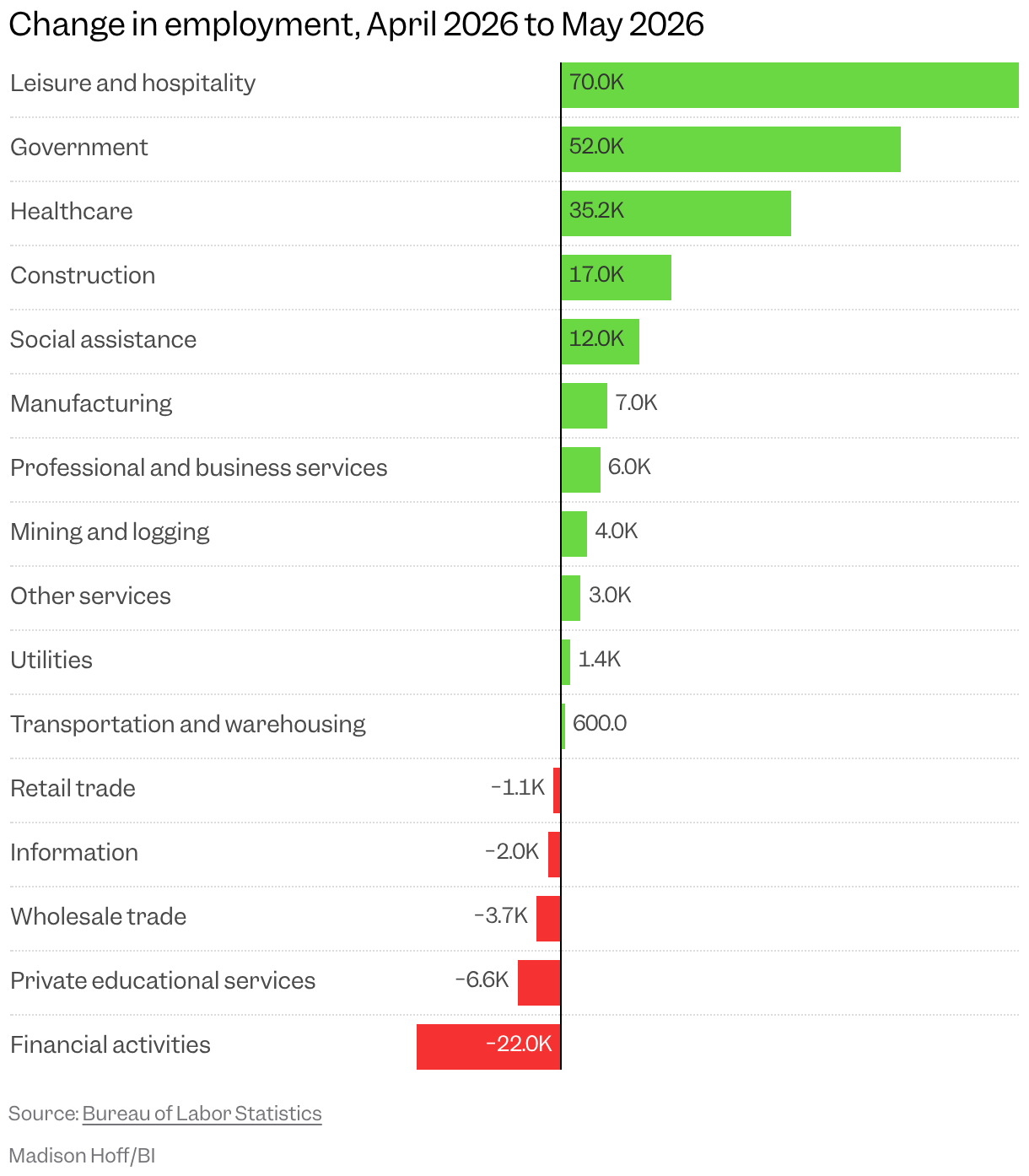
Healthcare, which has been an engine of growth for the past couple of years, isn’t the only field propping up the job market. Leisure and hospitality had the highest net gain last month, likely partly driven by World Cup demand, followed by government and healthcare.
While many sectors are adding jobs, Kory Kantenga, LinkedIn’s head of economics for the Americas, said there’s still a lack of hiring momentum across the board. He said healthcare is the only sector that’s largely been consistent over the past few years.
“The success or not for job seekers depends upon what sectors they are searching in and their location,” said Mark Hamrick, senior economic analyst at Bankrate.
Meanwhile, the April JOLTS report from the Bureau of Labor Statistics showed job openings surged to the highest rate since 2024, driven by professional and business services. Hamrick said the increase in job openings, muted layoffs and discharges, and low separations, “could set the stage for further acceleration in hiring.”
Outside the gold-standard jobs reports from the BLS, private data releases showed the job market’s strength. HR services platform Gusto highlighted in its monthly report that small businesses across most sectors added jobs last month, with gains across all US regions. ADP similarly reported that private job gains were strong across firm sizes and in most sectors, with its chief economist, Nela Richardson, saying there’s sustained momentum heading into the summer.
The healthy job growth in the job market doesn’t mean people should dismiss high-profile layoff news at large companies.
“A thousand people losing their jobs, that’s a thousand people,” Bachaud said. “That’s a very real, tangible number; for those thousand people, it’s a very terrible experience.” She added that 1,000 job cuts at one company don’t move the overall US employment needle.
But wages aren’t keeping up with inflation, and white-collar work is stagnating
The economy does have some pain points: ongoing uncertainty from the Iran war, inflation outpacing wage growth, and increased long-term unemployment.
The robust job gains don’t mean we are out of the woods from the low-hire job market. “Tech is low-hire, some fire, while other sectors are low-hire, low-fire,” Laura Ullrich, the director of economic research in North America at the Indeed Hiring Lab, said.
Finding work is persistently hard in some white-collar fields. The financial activities sector, where employment has generally been falling for about a year, lost 22,000 jobs in May. The information sector, which includes media and tech, has mainly experienced monthly job loss over the past few years.
Data from the Bureau of Labor Statistics showed the hiring rate dipped in April to 3.2%, which Glassdoor’s chief economist Daniel Zhao wrote is comparable to the 2010s, when the job market was still recovering from the Great Recession. Amid low hiring, people aren’t feeling too confident about finding a job, as seen in the low 1.9% quits rate, compared to a high of 3% during the Great Resignation period of 2021 and 2022.
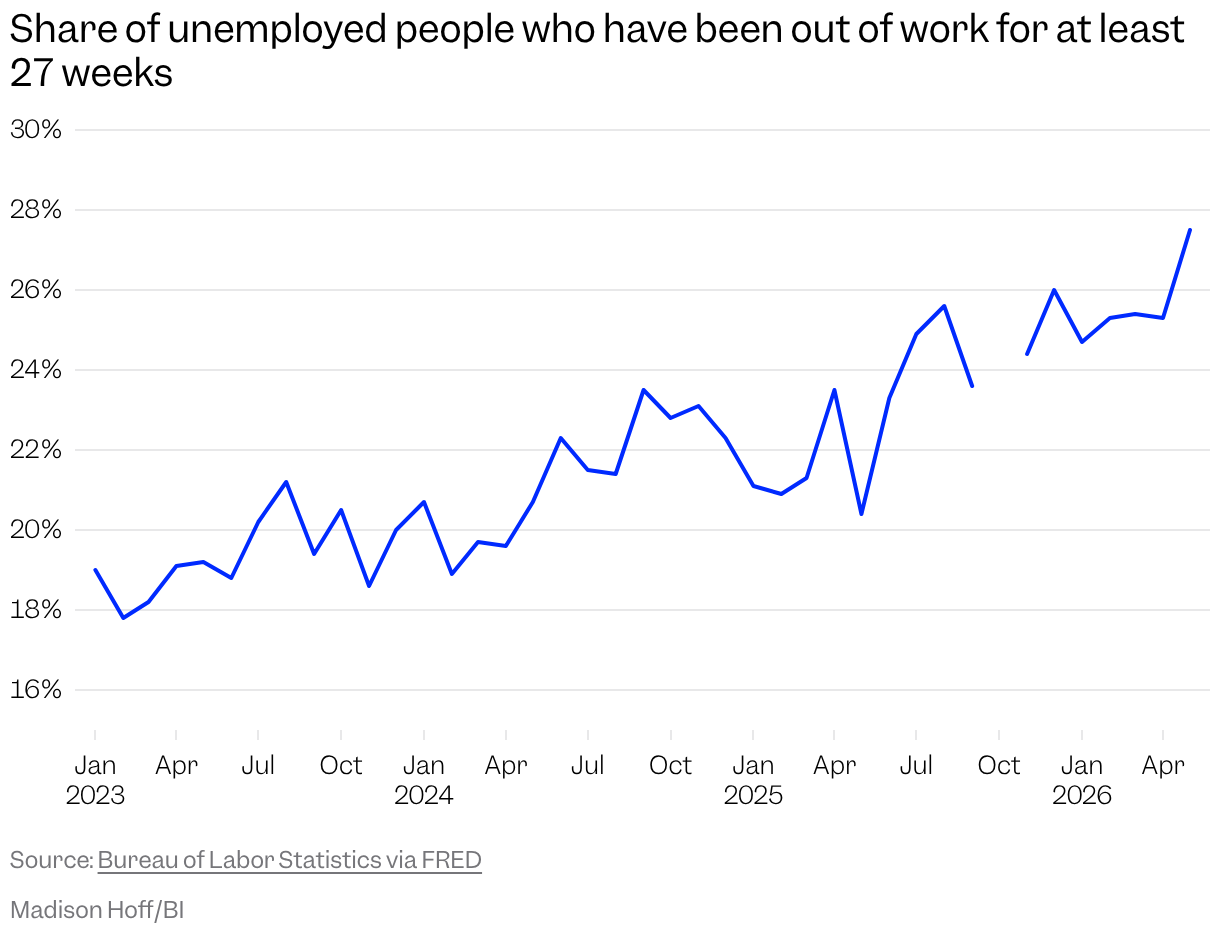
It’s also still hard to get out of long-term unemployment, or being unemployed for at least 27 weeks. Monthslong employment can have financial consequences, especially since many states offer just 26 weeks of unemployment benefits. Of the 7 million unemployed people in the US, 27.5% had been unemployed for at least 27 weeks in May, which Ullrich said is fairly high in an economy with healthy job creation.
“People who have been unemployed are having a really hard time transitioning out of that unemployment, and employers don’t really seem to be motivated to pull from that pool,” Bachaud said.
Wage growth has recently crossed an unwelcome threshold: it isn’t keeping up with inflation. Bachaud said this is especially creating financial strain for middle-income households. Inflation exceeded 4% for the first time since 2023 in May.
“More people are feeling worse off about their financial situation now than a year ago, and affordability is no doubt playing a role,” Elizabeth Renter, senior economist at NerdWallet, said in written commentary. “Higher and higher gas and food prices impact households in a dramatic way — these are things we can’t easily cut out of our budgets, or even reduce.”
How are you doing in today’s job market? Did you make a career trade-off, such as taking a lower-paying job because of better work-life balance? Reach out to this reporter to share at mhoff@businessinsider.com or fill out this form about career trade-offs.