UpTrajectory Review
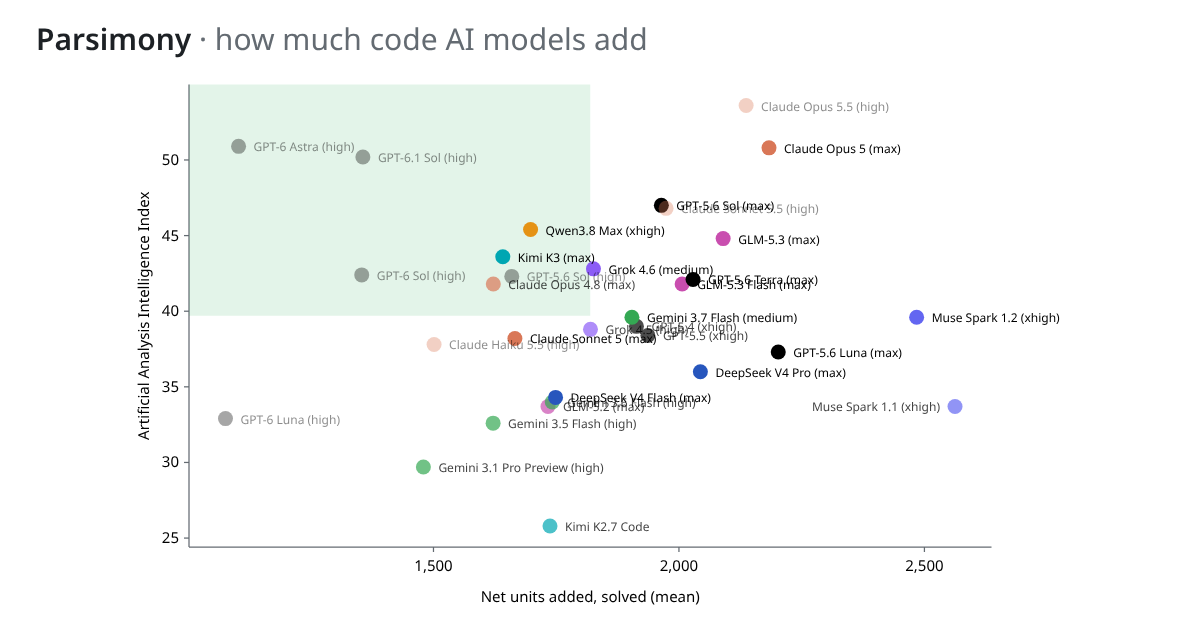
A new open-source benchmark called Parsimony is taking aim at a blind spot in how the industry scores AI coding models: not whether they solve the problem, but how much code they generate to do it. The author, lasu, argues that existing benchmarks like SWE-bench Verified and DeepSWE track solve rates and token costs, but ignore the downstream maintenance burden of bloated patches. The method is straightforward: it ingests the patches those benchmarks already publish and counts 'coding units' — syntax elements like statements, function calls, and literals — rather than lines of code, so minified or crammed code gets no advantage. Deleted code is subtracted, yielding a net measure of how much a model adds to a codebase.
For small-business operators who use AI coding assistants, this metric cuts closer to the bone than raw solve rate. A model that passes tests by generating 300 lines where 50 would do isn't saving you money — it's creating a liability. Every unnecessary branch, redundant variable, or over-engineered abstraction is code you'll pay to debug, review, and maintain long after the AI session ends. If you're embedding AI-generated patches into a lean codebase or a solo-maintained SaaS, parsimony isn't an academic virtue; it's the difference between a tool that compounds technical debt and one that actually accelerates your roadmap.
What's genuinely new here is the focus on net code addition as a first-class metric, not a footnote. Most benchmark discourse fixates on capability — can the model solve harder problems? — while treating output volume as a cost issue (tokens burned) rather than a quality issue (complexity introduced). Parsimony reframes verbosity as a defect. We're sympathetic to this, but skeptical of one thing: the author ran GPT-6 and Claude 5.5 manually on 3–10 tasks using personal subscriptions, rendering those data points as faded, unranked circles. That's honest disclosure, but it's not a meaningful sample. Treat those models' positions as suggestive at best.
The second-order effects are worth noting. If parsimony-style metrics gain traction, model providers may start optimizing for compact output — which could backfire if brevity comes at the expense of readability or robust error handling. A terse patch that skips validation logic might score well here while being worse in production. There's also a risk that developers start treating 'fewer coding units' as a proxy for good code, when the real goal is clarity and maintainability. Still, for teams drowning in AI-generated sprawl, having any signal that punishes bloat is a step forward.
What to watch: whether benchmark maintainers like SWE-bench or DeepSWE adopt net-code metrics natively, and whether model providers publish patch-level outputs for newer models so the faded-circle problem disappears. If you're evaluating AI coding tools for your team, don't wait for the leaderboard to mature — run Parsimony on your own repos or pull the public patches from the GitHub repo and compare how much code your current tool actually adds per accepted task. The gap between 'solves it' and 'solves it cleanly' is where your future engineering hours live.
“Existing benchmarks measure solve rate and token output/cost, but don't punish excess code, which makes a codebase harder to work with in the long term.” — Hacker News (front page)
Takeaway: A model that solves tasks with 3x the necessary code isn't saving you time — it's mortgaging your future maintenance budget.
Excerpt from the original — Hacker News (front page)
Existing benchmarks measure solve rate and token output/cost, but don't punish excess code, which makes a codebase harder to work with in the long term. I wanted to measure this since it matters most for long-term projects.Method: it takes the patches that benchmarks already publish (DeepSWE, SWE-bench Verified, SWE-bench Live) and counts "coding units": syntax elements like statements, calls, names and literals. I didn't use lines of code, so cramming code isn't rewarded. Deleted code is subtracted, so it measures net units.GPT-6 and Claude 5.5 have no public patches yet, so I ran them myself on 3–10 tasks on my own subscriptions (shown as faded circles, not ranked).Any feedback or model contributions are welcome, especially public patch exports for newer models.GitHub: https://github.com/La5u/ParsimonyNot affiliated with any of the benchmarks.
Comments URL …