UpTrajectory Review
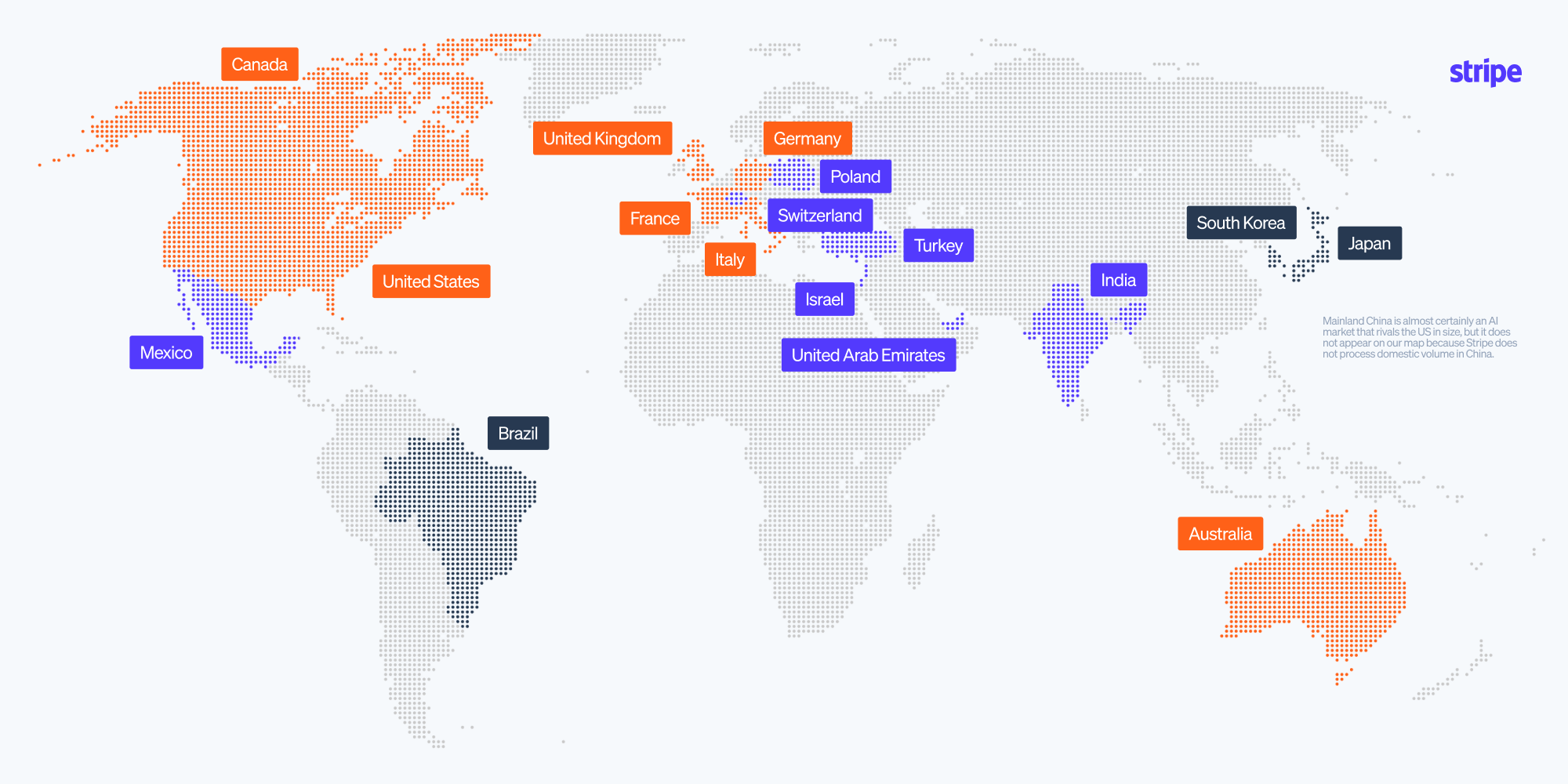
Stripe's data team has mapped where AI companies are expanding fastest worldwide, using transaction and incorporation data from the payment platform that serves as infrastructure for much of the startup economy. This is not a survey or analyst projection; it is behavioral data showing where AI firms are actually collecting revenue, hiring, and forming legal entities. The distinction matters because Stripe processes payments for a significant portion of venture-backed companies, giving it a vantage point that traditional trade data or government statistics lack. For small-business operators outside the AI sector, this map still functions as an early-warning system: where AI companies cluster, commercial real estate, professional services, and talent costs tend to follow.
If you operate a business that serves other businesses—legal, accounting, recruiting, catering, facilities management—the geographic pattern Stripe identifies should shape your expansion planning. AI companies are not distributed evenly; they concentrate in specific metros and, increasingly, secondary cities where costs are lower but technical talent remains accessible. The operators who anticipate these migrations rather than react to them capture pricing power. A commercial landlord in Austin or a payroll provider in Toronto who reads this signal correctly can lock in multi-year contracts before competitors recognize the demand shift. Conversely, those anchored to legacy tech hubs may find themselves holding depreciating assets as the center of gravity moves.
What is genuinely new here is the velocity, not merely the direction. Stripe emphasizes 'unprecedented rates of growth,' which, if the data holds, distinguishes this wave from previous tech expansions that unfolded over years rather than quarters. We are skeptical of 'unprecedented' as a default descriptor—every boom claims uniqueness—but Stripe's granular transaction data may substantiate it in this case. The under-reported tension is between this speed and the regulatory fragmentation these companies face. An AI firm can incorporate and start billing customers globally in days, yet faces diverging compliance regimes on data privacy, content moderation, and financial reporting that vary by jurisdiction. Stripe's map shows where demand is; it does not show where operations are legally sustainable long-term.
The downstream effects split unevenly across business types. Cloud infrastructure providers and GPU lessors benefit immediately and directly from AI expansion. Local service businesses benefit with a lag and only if they adapt their offerings—an AI engineering team has different purchasing patterns than a traditional software team, with more spending on compute credits and less on office perks. The cost structure of operating near these clusters also shifts: technical salaries inflate, but so do expectations for service speed and availability. A restaurant or dry cleaner near an AI hub may find volume up but staffing harder, while a remote competitor serving the same firms via delivery or SaaS captures margin without the overhead.
Watch whether Stripe releases this data on a recurring basis—quarterly or annual maps would transform this from a snapshot into a trackable indicator. Also watch for government responses: jurisdictions seeing rapid AI incorporation may accelerate regulatory frameworks, either to capture tax revenue or to address public concern, which could cool growth in currently hot locations. For operators, the actionable move is to identify which AI subsectors Stripe's data weights most heavily—generative AI infrastructure, applied AI tools, AI services—and assess whether your business model intersects with their procurement patterns. The firms that treat this expansion as a demand signal rather than a sectoral curiosity will find entry points before the market prices them out.
Stripe's analysis carries an implicit bias toward its own customer base, which skews toward venture-funded, digitally native companies. AI growth in state-backed enterprises, bootstrapped firms, or regions where Stripe has limited penetration may be undercounted. This is not a flaw to dismiss but a lens to adjust. The map remains useful precisely because it is incomplete: it shows where the commercially aggressive, globally oriented segment of AI is heading, and that segment often pulls broader economic activity in its wake. Small-business operators should read it as one signal among several, but a timely one.
Takeaway: Map your services against AI procurement patterns now, before geographic demand shifts lock in local pricing and competition.
Excerpt from the original — Stripe Blog
AI companies are undergoing rapid global expansion while achieving unprecedented rates of growth. We analyzed Stripe data to understand where global demand is the strongest, and how companies can build to best capture that demand.