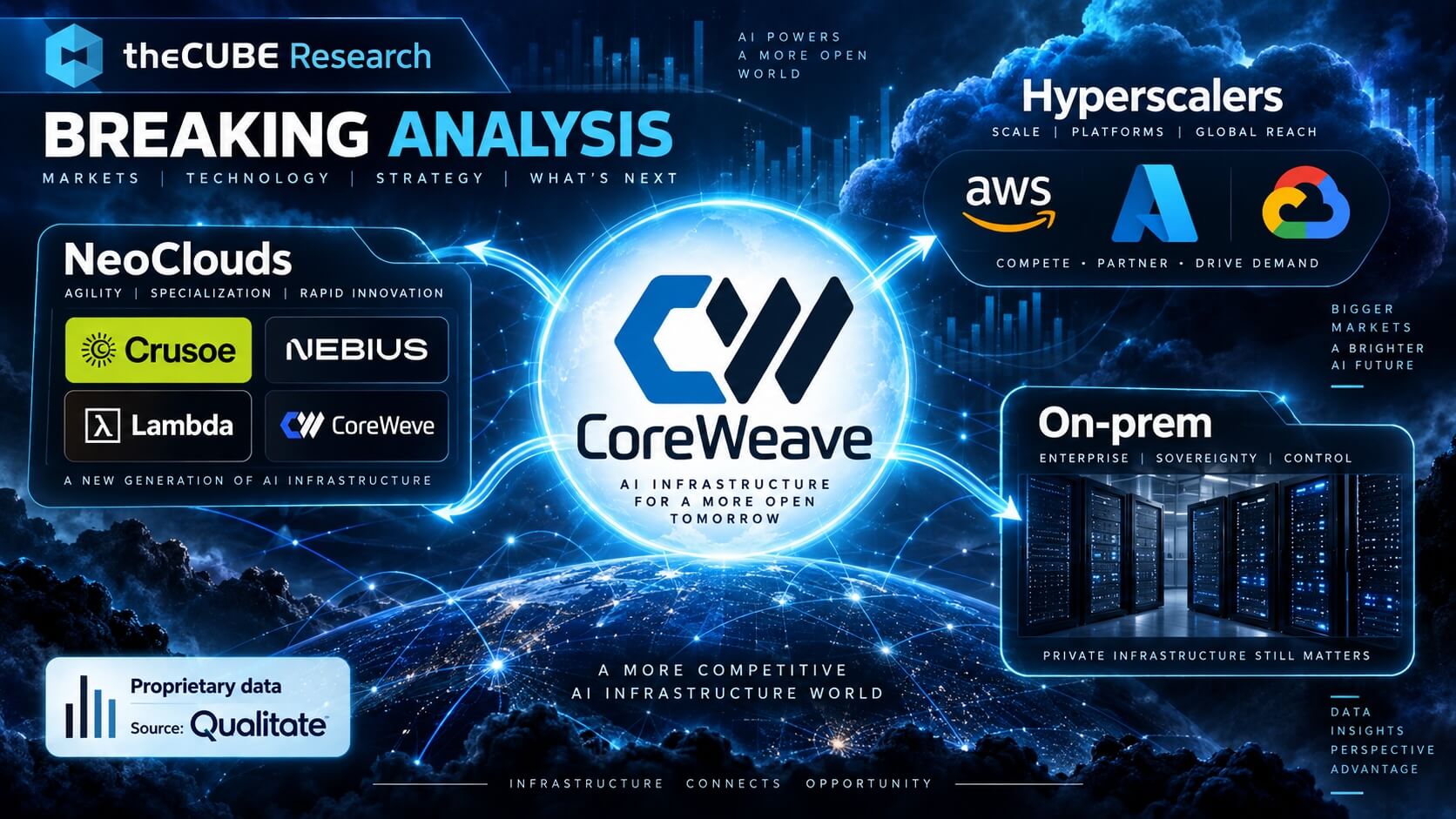
UpTrajectory Review
Dave Vellante's piece ahead of CoreWeave's Fully Connected conference signals that SiliconAngle is doing something most AI infrastructure coverage skips: original customer research. Rather than rehashing the earnings call, Vellante's team partnered with Qualitate to conduct 13 in-depth interviews totaling more than seven hours with the people actually evaluating, buying, and running AI infrastructure. The headline frames the tension plainly — CoreWeave built its business on GPU scarcity, and the open question is whether it can convert that into a durable AI cloud business as supply normalizes. The available excerpt is thin, but the framing tells us this is an analysis piece, not a news recap.
For a small-business operator, this matters because AI infrastructure costs are not an abstract enterprise concern anymore. If you are running a business that touches AI — whether through APIs, hosted models, or custom workloads — the pricing power of GPU cloud providers like CoreWeave directly affects your operating costs. When GPUs are scarce, providers charge premium rates and lock customers into long-term commitments. When scarcity eases, pricing pressure shifts. Understanding where CoreWeave sits in that cycle helps you anticipate whether your AI costs are likely to rise, hold, or drop over the next 12 to 24 months.
The genuinely interesting move here is the methodology. Earnings calls are stage-managed by design; customers who have signed contracts are often locked in and reluctant to speak candidly. Going to 13 practitioners with seven-plus hours of interview time suggests SiliconAngle is trying to surface sentiment that does not show up in quarterly filings — things like whether buyers feel over-committed, whether they are exploring alternatives, and whether CoreWeave's value proposition holds up when competitors like Lambda, Crusoe, and the hyperscalers themselves are all racing to offer GPU capacity. We are inclined to trust this approach more than analyst notes that rely on management guidance alone.
The second-order effects cut in multiple directions. If CoreWeave's customers are indeed nervous about over-provisioning, that could signal a broader cooling in AI infrastructure spending that would eventually flow downstream to software vendors, startups, and even small businesses that depend on AI-powered tools staying affordable. On the other hand, if the research shows customers are doubling down, it validates the massive capital expenditures flowing into data centers and suggests that AI compute demand remains genuinely insatiable. Either outcome has implications for how much leverage small businesses will have when negotiating AI service contracts.
Watch what comes out of the Fully Connected conference itself, particularly whether CoreWeave announces new customer commitments, pricing structures, or partnerships that go beyond raw GPU rental. The real test is whether the company can layer managed services, software tooling, or industry-specific offerings on top of its hardware advantage. For operators, the practical step is to audit your current AI spend and understand how much of it is tied to GPU-dependent services versus API-based tools. If a significant portion rides on GPU pricing, now is the time to explore multi-provider strategies before any market shift catches you locked into unfavorable terms.
“Rather than simply repeat the earnings call, we went to the people evaluating, buying and running the infrastructure.” — SiliconAngle
Takeaway: Audit your AI spend now to understand GPU exposure before CoreWeave's scarcity-to-durability transition reshapes cloud pricing.
Excerpt from the original — SiliconAngle
Ahead of CoreWeave Inc.’s Fully Connected conference in San Francisco, we have made a notable investment in proprietary customer research with Qualitate. Rather than simply repeat the earnings call, we went to the people evaluating, buying and running the infrastructure. This analysis draws on 13 in-depth interviews and more than seven hours of interview time. […]
The post CoreWeave’s next test: From GPU scarcity to a durable AI cloud appeared first on SiliconANGLE.