
UpTrajectory Review
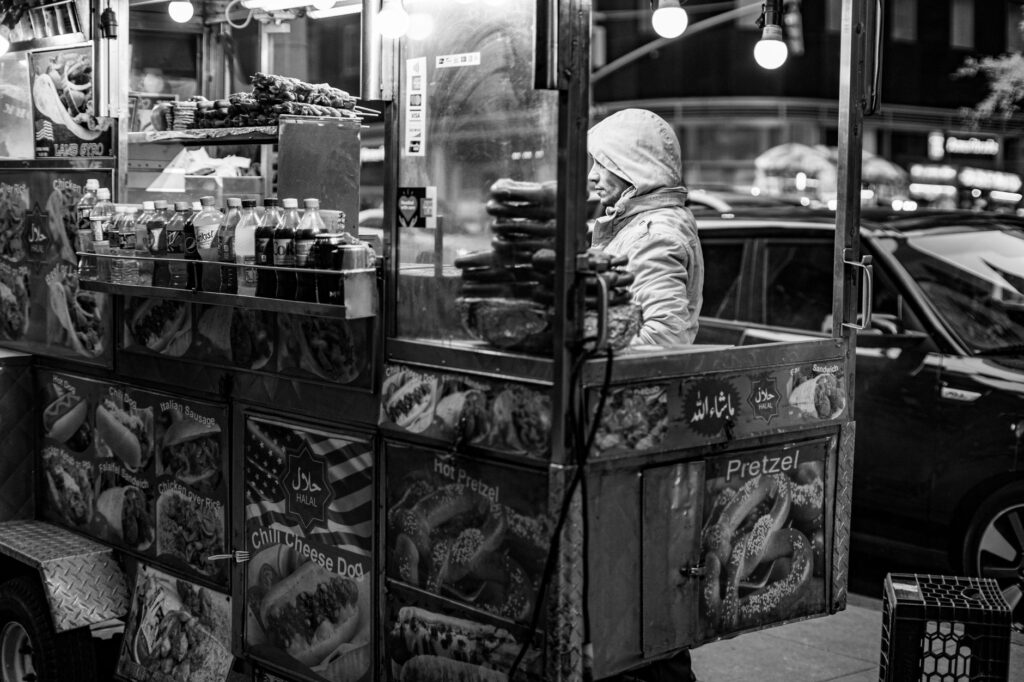
New York City's street vendors are caught in a squeeze that inflation alone does not explain. Tamer Hassan, who operates four carts near Times Square selling everything from smoothies to halal plates, illustrates the problem plainly: two years ago he netted 80 cents per $3 hot dog; today he nets the same 80 cents per $5 hot dog. The culprit is not greed but compressed margins across every input—food, supplies, labor, insurance, propane, cart maintenance. On a $3,000 daily gross, Hassan keeps roughly $200. This is the reality facing over 20,000 street vendors citywide, many of whom are aging into exhaustion and questioning whether the business remains viable.
Street food is not a luxury market for New Yorkers—it is a practical lunch option and a cultural touchstone. Halal plates have become iconic affordable meals, and their rising cost signals that even the lowest-friction food retail is no longer cheap. For a small-business operator running tight margins, Hassan's math is instructive: vendor economics show how cost inflation cascades through every layer of a supply chain, and how even high volume cannot protect against compressed unit economics. If seasoned vendors like Hassan are planning their exit, replacement vendors will enter a system even less forgiving than the one they inherited.
Mayor Zohran Mamdani's campaign promise to 'make halal $8 again' acknowledges the problem and gestures at solutions—lower operating costs, more permits, reduced barriers to entry. That rhetoric is encouraging, but the article does not specify which costs would fall or how. Permit fees, licensing overhead, and cart rental or storage costs are city-controlled levers; commodity prices for chicken, rice, and propane are not. The gap between the slogan and actual policy remains unexamined here. Mamdani's framing also risks treating vendor economics as a political symbol rather than a structural problem: inflation has been real, but so have years of incremental cost increases that predate recent price spikes.
If Hassan's carts vanish—whether he sells or his son declines to inherit—the city loses not just a business but a labor force. Street vendors absorb weather, long hours, and physical toll for thin returns; they are not easily replaced by younger workers unless operating economics improve. Attrition here reduces food access in high-foot-traffic areas, concentrates retail toward established chains with scale, and shrinks the informal economy that has historically served immigrant operators. A five-year countdown to Hassan's exit is a warning signal, not an outlier.
Watch whether Mamdani's administration moves beyond messaging to concrete cost relief—permit streamlining, utility subsidies, or negotiated supply contracts that lower vendor input costs. Operators should document their own cost structures and margins, share data with municipal advocates and vendor associations, and signal which specific expenses would matter most to survival. The story of street-food affordability is really a story about who can afford to operate retail in the city at all.
“Two years ago, we could sell $3 hot dogs at an 80-cent profit. Now, if we sell them at $5, we still make 80 cents.” — Business Insider
Takeaway: Street vendor margins compress despite price hikes; understand your true per-unit profit against all inputs.
Excerpt from the original — Business Insider
José A. Alvarado Jr.Tamer Hassan is ready to get out of the street food game.He manages four food carts — smoothies, hot dogs, chicken and rice — on 49th Street, just off Times Square. At 45, he's been doing it for a decade.He loves the work, but is determined to leave the industry in the next five years, which means selling his business or convincing his son (an 18-year-old engineering student) to take over. The hours on his feet in all kinds of weather feel impossible to keep up with as he ages. Not to mention the meager returns.
@media (min-width: 768px) {
.vertical-image-wrapper {
display: flex;
justify-content: center;
}
.vertical-image-wrapper .vertical-image {
width: min(calc(80vh * var(–img-w) / var(–img-h)), 100%);
min-width: 0;
}
}Tamer Hassan manages four food carts near Times Square.  …